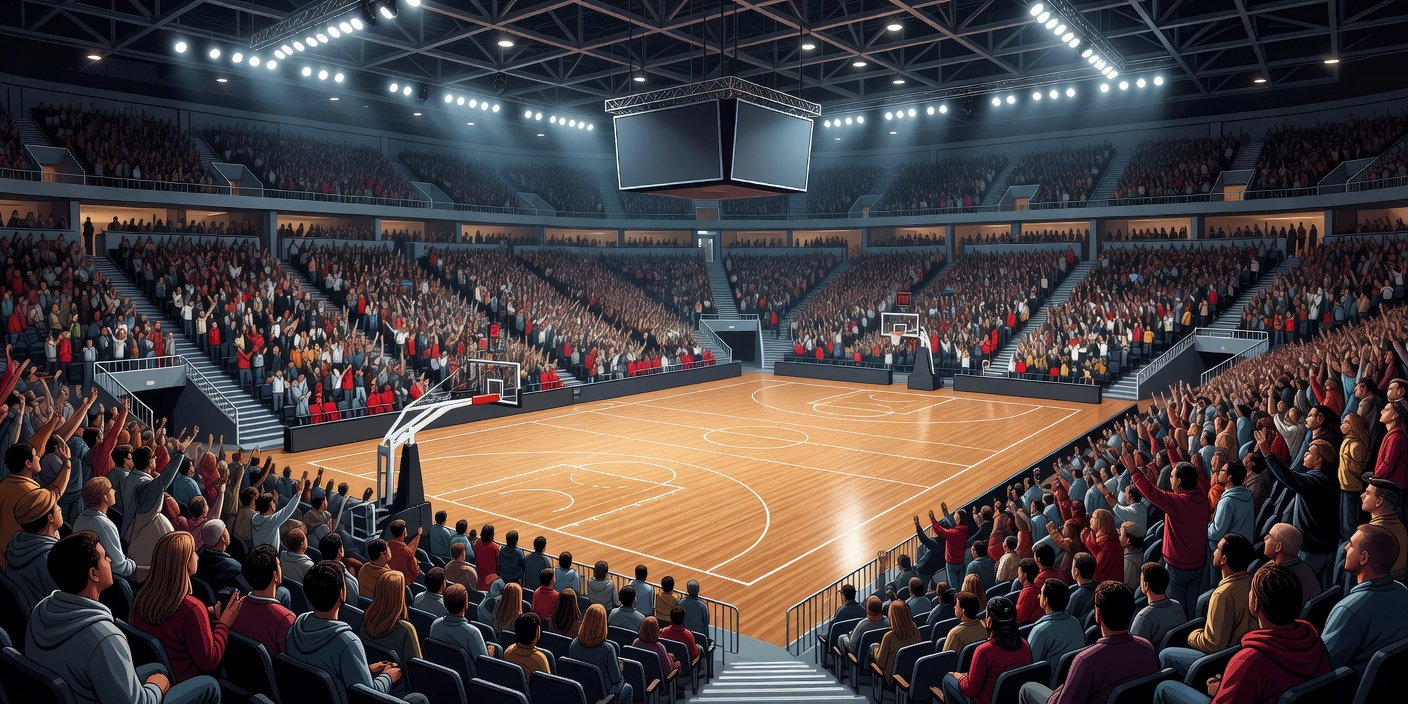
Indoor sport does not need October the way a marathon does; it needs a building. Most European arenas serve more than one tenant and a commercial events programme, so an indoor league's fixture list is a negotiation between competition organisers, clubs and venue operators. That constraint, plus the international windows each sport reserves, explains most of the apparent irregularity in an autumn schedule.
Basketball
The European basketball season opens through late September and October. The EuroLeague, run by EuroLeague Basketball rather than by FIBA, plays a long double round-robin regular season across midweek evenings, with clubs travelling continually between Spain, Turkey, Greece, Italy, Israel, Germany, France, Serbia and Lithuania. The EuroCup runs alongside it, and FIBA organises the Basketball Champions League and the FIBA Europe Cup as parallel continental competitions.
Domestic leagues start in the same period: Liga Endesa in Spain, Lega Basket Serie A in Italy, the Basketball Bundesliga in Germany, LNB Élite in France, the Greek league and the Turkish league among them. Clubs in continental competition therefore play twice or three times a week from October onwards. National-team windows in basketball fall later in the autumn and in winter, which is why the club season can run through October uninterrupted.
Handball
Handball's continental competition, the EHF Champions League, plays its group phase from September through the autumn, mostly at weekends, which pushes domestic rounds into midweek. The sport's strongest domestic structures are in Germany, France, Denmark, Spain, Hungary and Poland, and the clubs at the top of those leagues supply most of the continental field.
Handball differs from basketball in one calendar-relevant way: its major international tournaments are held in January, and the European and world championships alternate. That places a hard stop in midwinter, so autumn is when domestic and continental fixtures are packed most densely.
Ice hockey
European ice hockey starts earlier than the other arena sports. The Champions Hockey League begins in late summer, and the national leagues — the SHL in Sweden, Liiga in Finland, the National League in Switzerland, the DEL in Germany, the Czech Extraliga and the Austrian-based multinational league — open in September. By October the season is well established, with frequent midweek fixtures because ice time and arena slots, rather than travel, set the limit.
The North American season also opens in October, which matters to European audiences for two reasons: it draws away players who would otherwise be in European squads, and the NHL periodically stages regular-season games in European cities.
Volleyball
Volleyball's domestic leagues begin in October across Italy, Poland, Turkey, Russia's neighbours in eastern Europe and the Balkans, with the CEV Champions League Volley starting later in the autumn after qualifying rounds. Italy's SuperLega and Poland's PlusLiga are the reference points for the men's game; the Turkish women's league is a consistent power in the women's competition. Volleyball's international calendar is unusual in taking most of the summer, which pushes the club season back and makes autumn the true start rather than a continuation.
The indoor tennis swing
Tennis moves indoors in October. After the Asian hard-court events, the tour returns to Europe for a run of indoor tournaments — Antwerp, Stockholm, Vienna and Basel among them — before the Paris Masters, the last of the season's top-tier men's events and the only one played indoors. The season then closes with the men's and women's finals events in November, contested by a small qualifying field drawn from ranking points accumulated across the year.
Indoor conditions change the tennis itself: no wind, no sun, consistent bounce and generally quicker play, which tends to reward serving and flat hitting. It is the one part of the professional tennis year where conditions are close to identical from venue to venue.
Shared arenas, shared problems
Because a single arena may host basketball, handball, ice hockey, concerts and conferences, autumn scheduling in these sports contains more compromises than football's does. Fixtures move at short notice, kick-off and tip-off times vary within the same league, and a club in continental competition may play a home match on an unusual weekday because that was the only slot available. Ice rinks add a further complication: converting a rink to a court and back is possible but slow, so multi-sport venues cluster fixtures by surface.
Picking up an indoor league in autumn
- Start with the continental competition — it condenses the strongest clubs into one schedule.
- Check whether a league uses a regular season plus play-offs; most of these do, and autumn results only seed the later rounds.
- Look for the international windows in that sport before assuming a blank week is a break.
- Arena capacity varies enormously between clubs in the same competition; check the venue, not the league.
- Standing sections and singing ends exist in handball and ice hockey much as in football, and are usually the cheapest tickets.