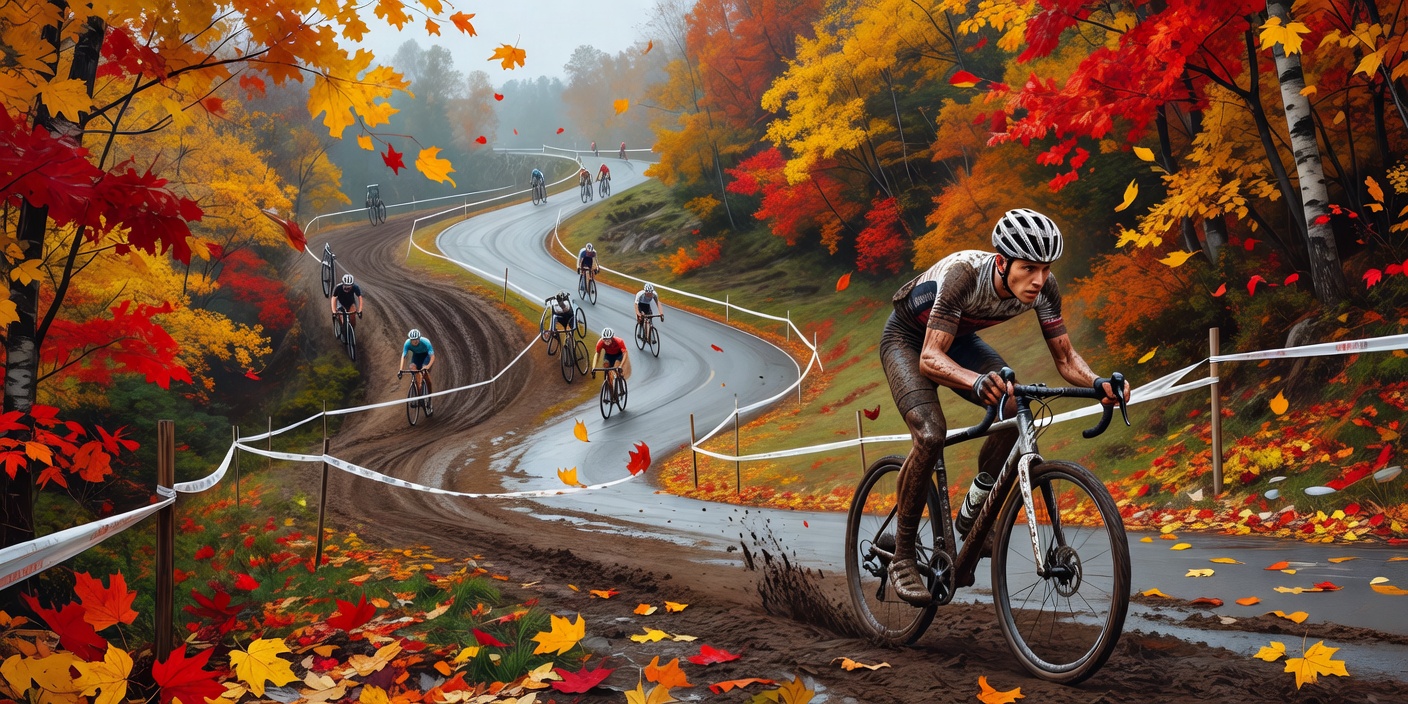
The professional road season ends in October, and it ends in Italy. After the grand tours and the world championships, the calendar contracts into a run of hilly one-day races in Lombardy, Piedmont and Emilia-Romagna, finishing with Il Lombardia — the last of the five Monuments, and traditionally known as the race of the falling leaves. Within days, attention moves to fields and forest circuits, where a completely different discipline has been building since late summer.
The Monuments and where Lombardia sits
Five one-day races carry Monument status: Milan–San Remo, the Tour of Flanders, Paris–Roubaix, Liège–Bastogne–Liège and Il Lombardia. The first four fall in spring; Lombardia closes the set in October. The difference is not only the date. Lombardia is a long, climbing race around the lakes north of Milan, so it suits riders whose form was built for grand tours, while the spring Monuments reward classics specialists and sprinters.
The Italian autumn races that precede it are a coherent group. Giro dell'Emilia finishes with repeated ascents of the steep climb to the basilica above Bologna. Tre Valli Varesine and Gran Piemonte use similar terrain in the pre-Alpine hills. Together they form a short sequence in which the same climbers appear repeatedly.
Paris–Tours and the northern finish
France's autumn classic, Paris–Tours, is one of the oldest races on the calendar and has been reshaped in recent editions to include unsurfaced vineyard tracks in the closing hour. That change moved it away from being a sprinters' race and towards something closer to a hybrid of classic and gravel racing — which also connects it to the UCI's gravel world championships, held in autumn.
Why the road season ends when it does
Three constraints close the road year. Weather in the high mountains becomes unreliable, so stage racing is impossible. Team contracts and rider transfers take effect from the start of the calendar year, so squads begin to disperse. And riders who have raced from late January need a genuine break before the next build. The season therefore tapers rather than stops: fewer races, shorter start lists and a noticeable drop in the number of teams travelling.
Cyclo-cross takes over
Cyclo-cross is raced on short circuits of grass, mud, sand and gravel, with obstacles that force riders to dismount and carry the bike. The season runs from late summer through to the world championships, held in the depth of winter, and its heartland is Flanders and the southern Netherlands, where a race can draw a crowd on a wet Sunday in a way no other winter sport locally does.
The competitive structure is unusual because several parallel series coexist: the UCI Cyclo-cross World Cup, the Superprestige and the X2O Badkamers Trofee, plus a large number of one-off races that are not part of any series. Riders pick and choose, so the strongest field of the weekend is not always at the World Cup round. One fixed date is worth knowing: the Koppenbergcross, run on the cobbled Koppenberg climb in East Flanders, is traditionally held on 1 November.
Equipment and the pit
Cyclo-cross technique is where autumn conditions become visible. Riders run two identical bikes and swap them in a designated pit area as mud accumulates, with mechanics jet-washing the bike just handed over. Tyre choice and pressure are the main variables — low pressure for grip in mud, higher for hard, frozen or sandy courses — and tubular tyres remain common at the top level for that reason. Course design must include sections where riders dismount, which is why hurdles, steep run-ups and sand pits recur.
Track racing and the winter indoors
The third strand of the autumn is track cycling. Once the road season closes, velodromes across northern Europe fill up: the UCI Track Champions League runs as a compact series of rounds in late autumn, and the six-day tradition continues in Ghent, where racing at the small, steeply banked Kuipke velodrome remains one of the sport's distinctive winter events. Track racing suits the season for the obvious reason — it is indoors, under lights, on a fixed surface, and immune to a wet November.
Watching in person
Autumn is arguably the easiest time of year to watch professional cycling live. One-day races pass a given point once, so a hill with a view is worth more than a finish-line barrier. Cyclo-cross is the opposite: the circuit is short, riders pass repeatedly, and the whole race is visible from a single vantage point, which is why cross events sell tickets and road races generally do not.
Following the autumn cycling calendar
- Track the Italian one-day races as a sequence — the same riders contest all of them.
- For cyclo-cross, check which series a race belongs to before assuming who will start.
- Expect course conditions, not distance, to determine the winning margin off-road.
- Look up transfer and parking arrangements for cross venues; most are in small towns.
- Dress for standing in a field for three hours — the racing is short, the wait is not.